Click here for larger
Click here for larger
Click here for larger
| . |
The Ulysses S. Grant Memorial Website ... is one of more than 1,000 memorials featured at ... dcMemorials.com |
. |
|
Click here for larger |
|
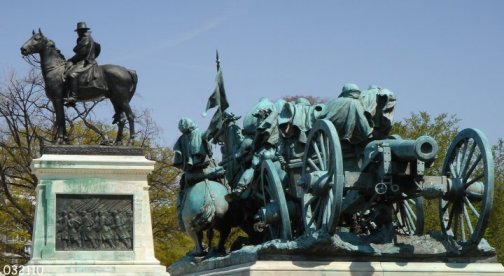
| The impression of actual activity is almost startling in its realism, and the whole memorial epitomizes the spirit of battle and the generalship of Grant. The Artillery and Cavalry groups, with their rearing and plunging horses, the riders straining forward in their saddles, or bracing themselves against a sudden shock, with one horse that has fallen, throwing its rider headlong, producing arrested action, dramatic interest and suspense, are without parallel in any sculpture in existence. | |
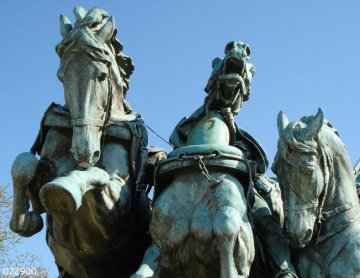
| From artistic and historic standpoints the Artillery and Cavalry groups are especially interesting because every detail of horse and rider, every trapping of gun and battle impedimenta, is faithfully reproduced. As an illustration of the painstaking care exercised throughout the entire work, attention is drawn to the lead horse in the Artillery group – this is one of the horses drawing the cannon. The guidon bearer has signaled for a right wheel. His horse [see right-most horse in image at right (Ed.)] is back upon his haunches and the guidon has been violently switched around against the wind. The near horse [center horse (Ed.)] has felt the jerk of the curb and is just settling back on his haunches, but the lead horse [left horse (Ed.)] is still plunging madly forward. One’s curiosity is aroused why one horse of the team is back on his haunches while the other is plunging forward. Examination of the bridles solves the mystery. The near horse is heavily curbed, while the strap has broken on the bridle bit of the lead horse and the driver is unable immediately to curb and arrest the motion of this lead horse. |
Click here for larger |
|
Click here for larger |
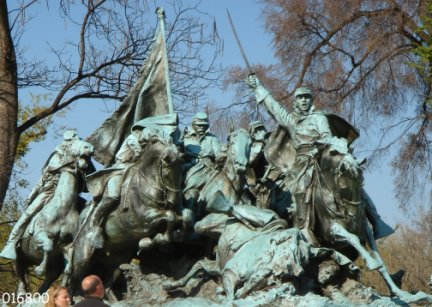
Another instance is in the Cavalry group. A trooper of this color squad is pinioned beneath a horse that has fallen [see image at left (Ed.)]. The leader of the squad, with sword upraised, is barking the order to charge, and is wheeling his horse toward the fallen mount, all unconscious of his comrade’s peril. The other riders of the group are likewise unaware of the fallen horse – all save the rider immediately to the rear of the horse that is down; and he, seeing the plight of his comrade, has instinctively thrown his arm across his face, and is desperately pulling his horse so as to avoid the fallen horse and rider. Here again can be studied the tense position of horse and rider, the slackened rein on one side, the taut rein on the other, and the horse's jaw pulled out of line in an intense effort to avoid a tragedy. |
